
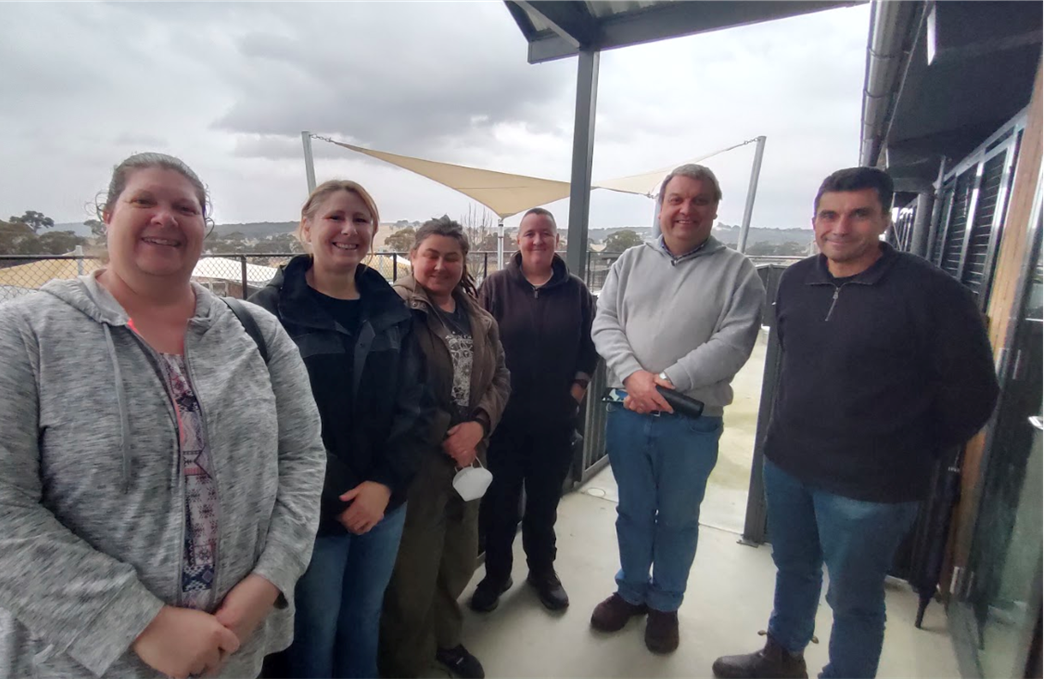
Earlier this month (August 2022), several members of the ACA Committee visited Rockley Valley Cavoodles at Bathurst. Rockley Valley Cavoodles is an intensive breeding facility breeding cavoodle puppies for Kellyville Pet Shop.
The first thing one notices upon arrival is that this purpose built facility has been thoughtfully designed to be dog friendly as well as easy to clean and maintain. Biosecurity standards are high – our first stop is to disinfect our shoes, hands and have the biosecurity protocols explained. The hardest rule to follow – no touching the puppies. Oh gosh, what a challenge for a team of animal lovers! I’m pleased to report that we all passed the test., despite the incredibly cute temptations put in front of us!
John Grima owns the facility and guided us on a tour of the property. The stud dogs live on site all year, and they all came running from playing on the far side of their large grass yard to greet us, tails wagging. John tells us their names and that most of them are house dogs. It can get cold out in Bathurst, and adjoining the yards through a doggy door is a heated room with beds for the dogs to relax in, even when they are out in the yard.
All of the female breeding dogs live off site on a Guardianship program. This means that the dogs live with a family, in their home, and only come back to the facility for breeding and whelping. After 3 litters over 3 years, the dogs are desexed, and ownership is transferred to their guardian for them to live out their lives at home. This arrangement means that dogs can be normal family pets and don’t live fulltime at the facility.
The whelping bays are well thought out for good welfare and are easy for staff to maintain and monitor. The bays surround the central, in house vet clinic, and laundry, and indoor puppy play and socialisation area. Its heated for the puppies and mums comfort. Each bay has an indoor and outdoor section. The dog bed is indoors and the puppies are born inside. There is a doggy door in each bay that allows mum to access the outdoor section of the bay. She has to step over a low barrier that keeps the puppies inside, so she can have a break from them when she chooses to. We saw 12 litters there at the time of our visit. The puppies and their mums were all appeared healthy and friendly and wanted our attention.
Outside is a large dog play area with toys, a shallow pool, kids play equipment to climb on and a huge dinosaur. The puppies have a checklist of handling and basic training goals to meet to prepare them for life with their new owners. Each puppy’s health and growth milestones and training achievements are recorded and monitored. The facility was deliberately designed to resemble a home environment. The gates are the kind you’d find in suburban backyards, the indoor areas resemble a normal kitchen. even the size of the yards is based on the size of a quarter acre block.
Much of the facility is empty. There’s empty yards, and empty whelping pens. It doesn’t feel very intensive, but there’s around 60 litters born at the facility each year.
We were all impressed with what was being achieved at Rockley Valley to ensure high welfare standards. With so many dogs in one place, it’s convenient for the RSPCA and local council to monitor, its easy to staff and to maintain a high standard. We know it exceeds the states minimum standards for intensive breeding facilities, and most facilities will not look like this. We know that puppy farms also exist that don’t try to meet any standards at all. Even with the additional government funded resources thrown at RSPCA NSW, their dedicated Puppy Farm Taskforce has failed to find them.
Most of us at ACA would prefer to see puppies raised in homes, with doting families, and not commercially raised in an intensive breeding facility, even temporarily in one as professional and thoughtfully planned as Rockley Valley.
Most state governments in Australia are now bending under pressure from Animal Rights groups to eliminate all puppies bred in private homes, even by ethical breeders. The restrictions and minimum staffing ratios being introduced into legislation means intensive breeding facilities are likely to become the norm, as demand continues to outstrip supply. How many will aim for the high standards set by Rockley Valley and how many will only maintain the bare minimum? Is that really what we want to see happen to dog breeding? Is this really a welfare improvement? Is this really the best we can do for our dogs?
By: Karri Nadazdy – Animal Care Australia Horse & Livestock Representative. Originally published: September 2022 ACE Newsletter.


