
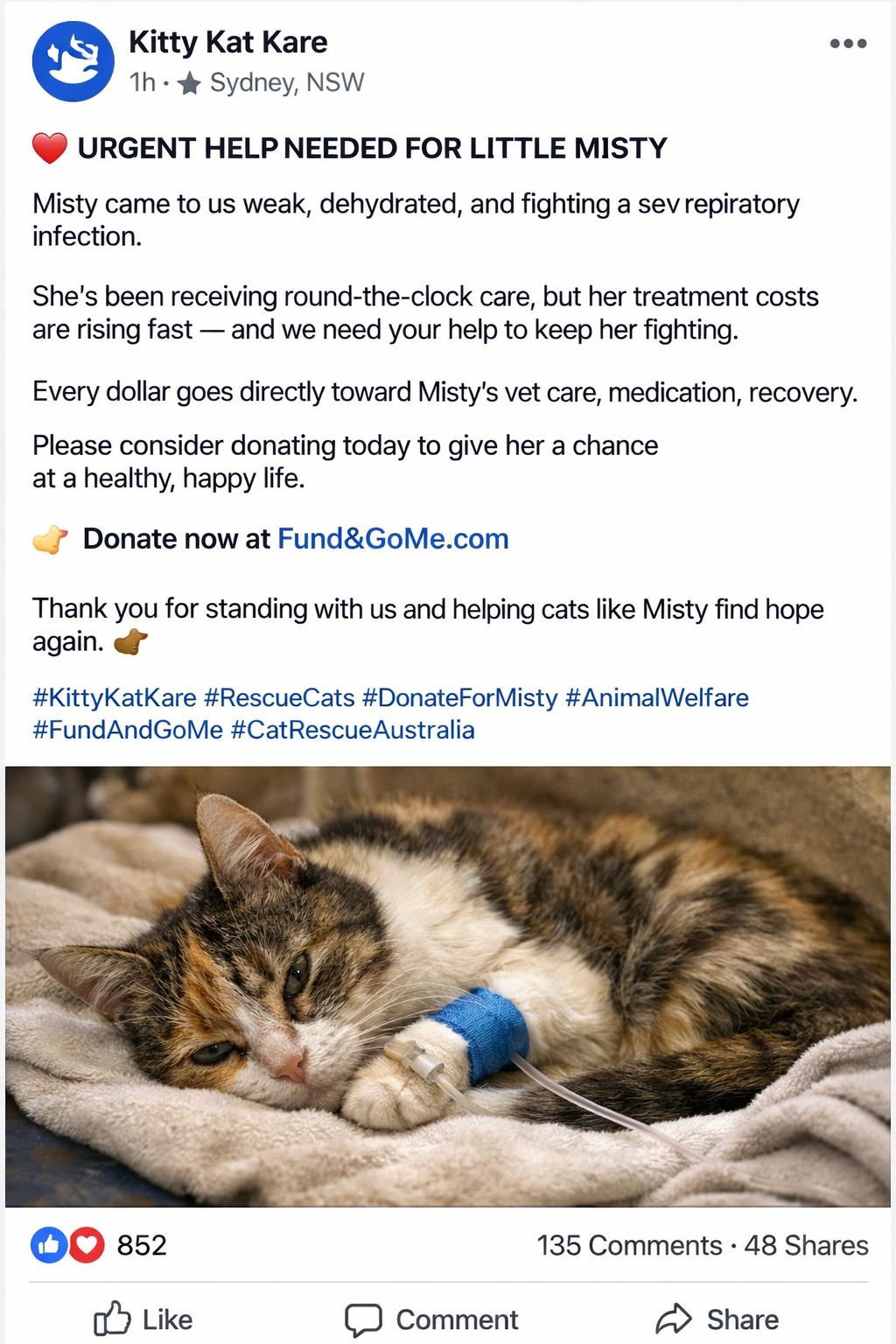
Anyone interested in animals will have seen the social media posts put out by rescues about their animals for adoption, needing surgeries, needing food or supplies, etc… yes? Many of these posts pull at our heart strings and many of us might even donate money, resources, or even our time and homes to foster animals.
But how often are we really looking at what may be going on behind the scenes?
Recently, I have come across at least 2 instances where seemingly lovely and caring rescues may have gotten well out of their depth by taking on far more animals than they could responsibly care for, and the animals have suffered because of this need to “save them all” at all costs.
The cat rescuer who takes cats from street colonies, desexes and tries to rehome them, but now has far too many cats housed in a residential property… to the point that numerous cats have fallen gravely ill and are requiring ICU veterinary treatment, not to mention the ones that have died. The GoFundMe’s for all of those cats bills totals well over $20,000 to date.
Then there is the recent case of 53 dogs from a rescue being “boarded” at a facility (and ostensibly run by another rescue) that was raided by the RSPCA, and dogs were found crammed into small wire crates stacked atop each other, and too many dogs crowded into outdoor kennels living in their own filth. Both the rescue that owned those 53 dogs and the rescue that owned the “boarding” facility were actively fundraising while these animals were certainly not receiving much in the way of actual care.
I have been involved with rescue for over 20 years in Sydney, and over those years have seen some pretty dodgy operators hanging out a shingle and calling themselves “rescues”. Rescues that overload foster carers with too may animals, those that rehome as quickly as possible to “make room” to “save” more animals, those rehoming unsuitable animals to unsuspecting families then refusing to take said animals back if it doesn’t work out, etc…
It’s pretty easy for someone to become a rescue really… just make up a cool name for said rescue and start posting to social media about animals in your care. Some source from “free to good home” advertisements or surrenders from the general public, some go to the trouble of registering as a business and/or a charity and register with government so they can source animals from pounds, but even these rescues can be dodgy with their practices, and animals are actually suffering poor welfare conditions as a result.
The reality is that there are very few checks and balances that need to be followed for anyone involved in rescue. Registered charities submit annual reports about their activities, but they are fairly vague and focuses more on how any money is earned or spent. Those registered with government also submit annual reports, but as in the case of the 53 dogs above (the rescue that owned them was registered with government and as a charity and still is today), one might surmise that those reports are either woefully inadequate to ensure actual animal welfare, or they aren’t being read or acted on when anomalies arise.
Breeders across Australia are being legislated/regulated more and more strictly, yet the numbers of animals finding themselves needing the rescue industry keeps growing – but no-one is monitoring what happens to them once they end up in rescue. Breeders are subject to audits by authorities at regular intervals, but rescues aren’t. Breeders must follow strict (and enforceable) Codes of Practice, but rescues don’t. Breeders are pilloried as the cause for needing a rescue industry, but rescues are often painted as lifesaving saints who can do no wrong – let me tell you, they can, and they are!
Unfortunately, Government don’t seem to be willing to address this serious gap in our animal welfare legislation, and animals are suffering at the hands of dodgy operators, or those who are just simply getting out of their depth. It takes much more than a big heart to do rescue in a way that truly benefits the animals that find themselves needing that rescue.
I am a foster carer for a local rescue group, and my “specialty” is mumma dogs and pups – a sad indictment that my “specialty is required, yes? Even though I do not have to follow any specific codes of practice, I adhere to the Breeders codes to produce the best outcomes for the animals in my care… it’s not all that difficult really, and my rescue coordinator loves that I always have all the required information at hand when animals go up for adoption.
What I love about the rescue I work with is that all foster carers are communicated with at regular intervals, and are supported with all food and resources that we may require to care for our fosters. There are many rescues that drop off foster animals to carers and expect them to provide all food and other resources, and in some cases vet bills also, then the rescue pockets the adoption fee once the animal is rehomed.
There are no set “rules” for how rescue should operate, so each rescue has its own systems in place. The only thing many rescues agree on is that they should all operate on the smell of an oily rag and not attempt to turn any sort of profit for the work that they do, which is quite frankly ridiculous. At the very least, any business (rescue) should be striving to recoup as much of the money they spend as possible, rather than constantly relying on the goodwill of strangers to fund their activities. Only taking in as many animals as you can adequately care for if no donations are forthcoming might be a good idea too.
Another huge problem that I have come across is that when a rescue is solely operated via social media, under a pseudonym, and with no physical address attached, if a welfare issue is identified, there is no way that the authorities can investigate. This means that there may well be thousands of animals squirreled away in dead-end “rescue” situations who are actively suffering, and there is absolutely nothing anyone can do about it as the current system stands.
It’s time for rescue to be officially regulated… do you agree?
By: Tracey Dierikx – Animal Care Australia Exhibited Animals Representative. Published: June 2026 ACE Newsletter


