
When we talk about dog training, it is often associated with puppies. puppy preschool, toilet training, learning to sit, walking on a lead and developing good manners. But training should never be viewed as something that only happens during the first few months of a dog’s life.
Every dog can benefit from training, regardless of the age at which they enter our homes.
Whether you purchase an eight-week-old puppy from a breeder, welcome an adolescent dog, rehome an adult dog or adopt through a shelter or rescue organisation, training and appropriate structure are important parts of helping that dog successfully adjust to life with you.
Puppies Need More Than Socialisation
Bringing home a young puppy is exciting, but it is also the beginning of a significant developmental period.
Puppies are learning from the moment they arrive. They are learning what behaviours result in positive outcomes, what their environment means, how people interact with them and what is expected of them.
This is why early training should be about much more than teaching “sit” or “drop”.
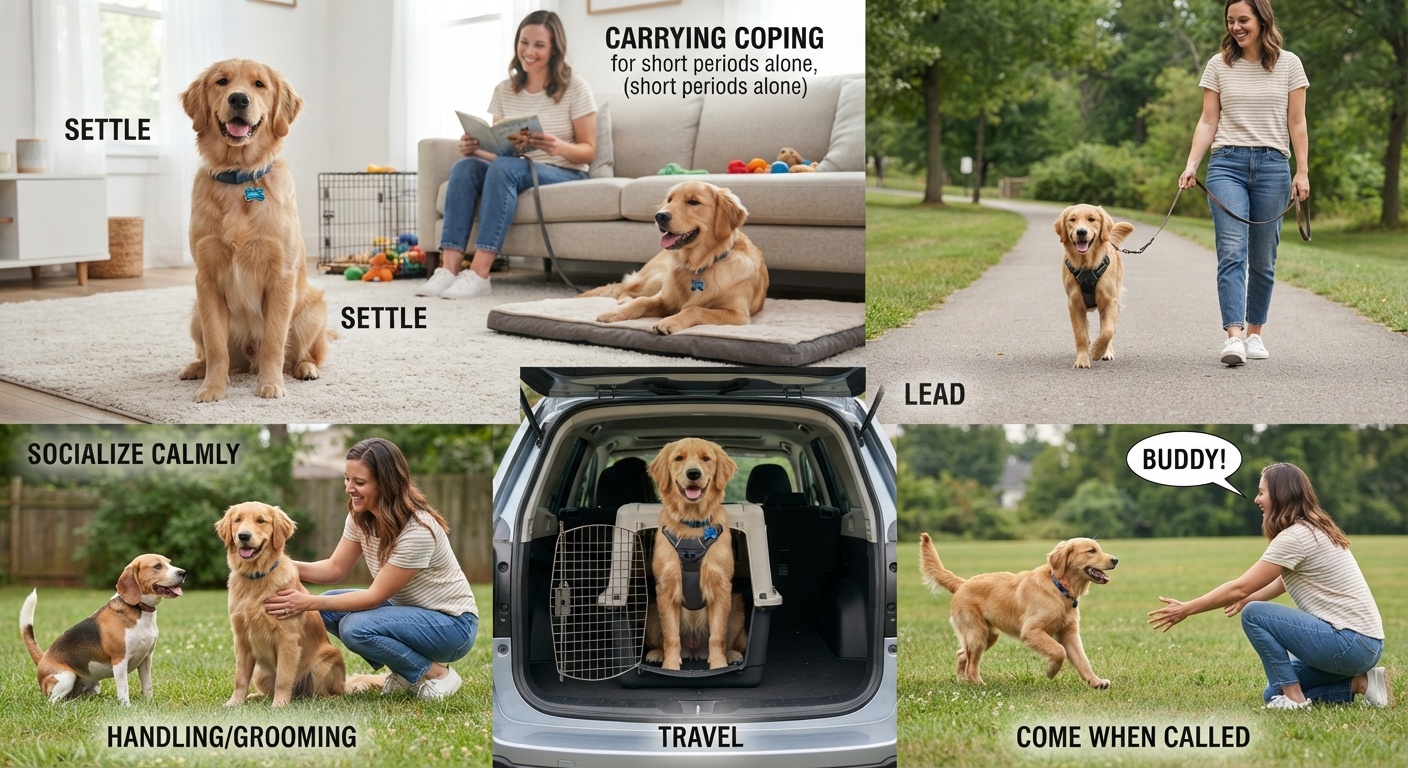
A young dog benefits from learning how to settle, cope with short periods alone, walk appropriately on a lead, interact calmly with people and other animals, accept handling and grooming, travel safely, respond to their name and come when called.
Just as importantly, they need opportunities to learn that not everything in their environment requires a reaction.
Socialisation should not simply mean meeting as many dogs and people as possible. Quality experiences, appropriate exposure and helping a puppy develop confidence and resilience are far more important than simply increasing the number of experiences they have.
Structure Is Not the Same as Restriction
The word “structure” can sometimes be misunderstood.
Providing structure does not mean removing choice, play or enjoyment from a dog’s life. It means creating predictability, consistency and appropriate boundaries.
Dogs need to understand how to successfully live within a human household and community. Clear routines and consistent expectations can make the environment easier for them to navigate.
Structure might include regular feeding and exercise routines, appropriate rest periods, consistent household expectations, planned enrichment and training sessions, boundaries around interactions and teaching a dog how to calmly disengage and settle.
For puppies in particular, this can be extremely valuable.
It can be tempting to constantly entertain a new puppy, take them everywhere and provide continuous interaction. However, learning to rest, spend appropriate periods independently and cope when nothing exciting is happening are also valuable life skills.
We are not simply raising puppies — we are raising the adult dogs they will become.
What About Rescue and Shelter Dogs?
Training and structure can be particularly important when bringing home a dog from a shelter, rescue or rehoming situation.
These dogs are not a single behavioural category. Some may have extensive training and have previously lived successfully in a home. Others may have limited experience of household life, while some may arrive with behaviours that have developed through their previous experiences.
Owners may also have incomplete information about a dog’s history.
One of the most helpful things we can provide during this transition is predictability.
Rather than immediately exposing a newly adopted dog to every possible experience, allowing them time to become familiar with their new environment, routine and household can provide an important foundation.
Training can then help establish communication between the dog and their new owner.
It provides opportunities to reinforce desirable behaviours, develop new skills and identify areas where the dog may require additional support.
Importantly, owners should avoid assuming that every behaviour displayed by a rescue dog is necessarily the result of trauma or abuse. Behaviour is influenced by many factors, including genetics, previous learning, environment, health and current circumstances.
Understanding the individual dog in front of us is far more valuable than making assumptions about their past.
Older Dogs Can Learn Too
The saying “you can’t teach an old dog new tricks” has probably done older dogs a great disservice.
Dogs continue to learn throughout their lives.
An adult dog entering a new household still needs to learn the expectations and routines of that household. Even a well-trained dog may need guidance because behaviours that were appropriate or reinforced in one home may be different in another.
Training older dogs can also provide valuable mental stimulation and enrichment.
Training should therefore not be considered something we complete.
It is an ongoing conversation between the dog and the person responsible for them.
Training Is About More Than Obedience
Perhaps one of the biggest misconceptions about dog training is that its primary purpose is to create an obedient dog.
Good training has a much broader role.
It helps dogs safely participate in our communities. It develops communication between dogs and their owners. It can provide mental stimulation, build useful life skills and give owners practical ways of managing their dogs in different environments.
A reliable recall, for example, is not simply an obedience exercise — it is an important safety skill.
Being comfortable with handling is not simply about compliance — it can make veterinary examinations, grooming and routine care considerably easier.
Learning to settle calmly is not simply about having a quiet dog — it is a skill that can help a dog participate successfully in everyday family life.
There Is No Universal Training Program
Responsible training also means recognising that dogs are individuals.
Breed and breed purpose, genetics, age, previous experiences, environment, physical health, temperament and learning history can all influence behaviour.
What is appropriate for one dog may not be appropriate for another.
This is particularly important when behavioural concerns emerge. Significant fear, anxiety, aggression or sudden changes in behaviour should not simply be dismissed as a dog being “naughty”. Veterinary assessment may be necessary to rule out pain or other medical factors, and appropriately qualified behavioural or training professionals may be required.
Seeking assistance early can prevent owners and dogs from struggling unnecessarily.
A Lifetime Commitment
Responsible dog ownership involves much more than providing food, water and shelter.
Dogs live within a complex human environment, and we have a responsibility to help them understand how to successfully navigate it.
That responsibility begins when the dog enters our care — whether they are eight weeks old, eight months old or eight years old.
Training, appropriate socialisation, enrichment, boundaries, routine and ongoing learning all contribute to developing dogs that can participate safely and successfully within their families and communities.
Most importantly, we should stop thinking of training as something that happens to a dog for a few weeks when they are young.
Training is education — and education should continue throughout a dog’s life.
By: Kylie Gilbert – Animal Care Australia Dog Representative. Published: September 2026 ACE Newsletter


