
An Animal Care Australia Policy & Position Statement.
This Wild Horse Ownership Policy & Position Statement, sets out a position focused on achieving genuine animal welfare outcomes while recognising the heritage value of the horses and the need to protect sensitive environments and native wildlife.
Animal Care Australia calls for humane, practical solutions for Australia’s wild horses. The Policy provides a more balanced and welfare-focused approach to the management of wild horses across Australia, including the establishment of dedicated wild horse sanctuaries and expanded opportunities for humane rehoming.
Animal Care Australia does not support aerial culling of wild horses.
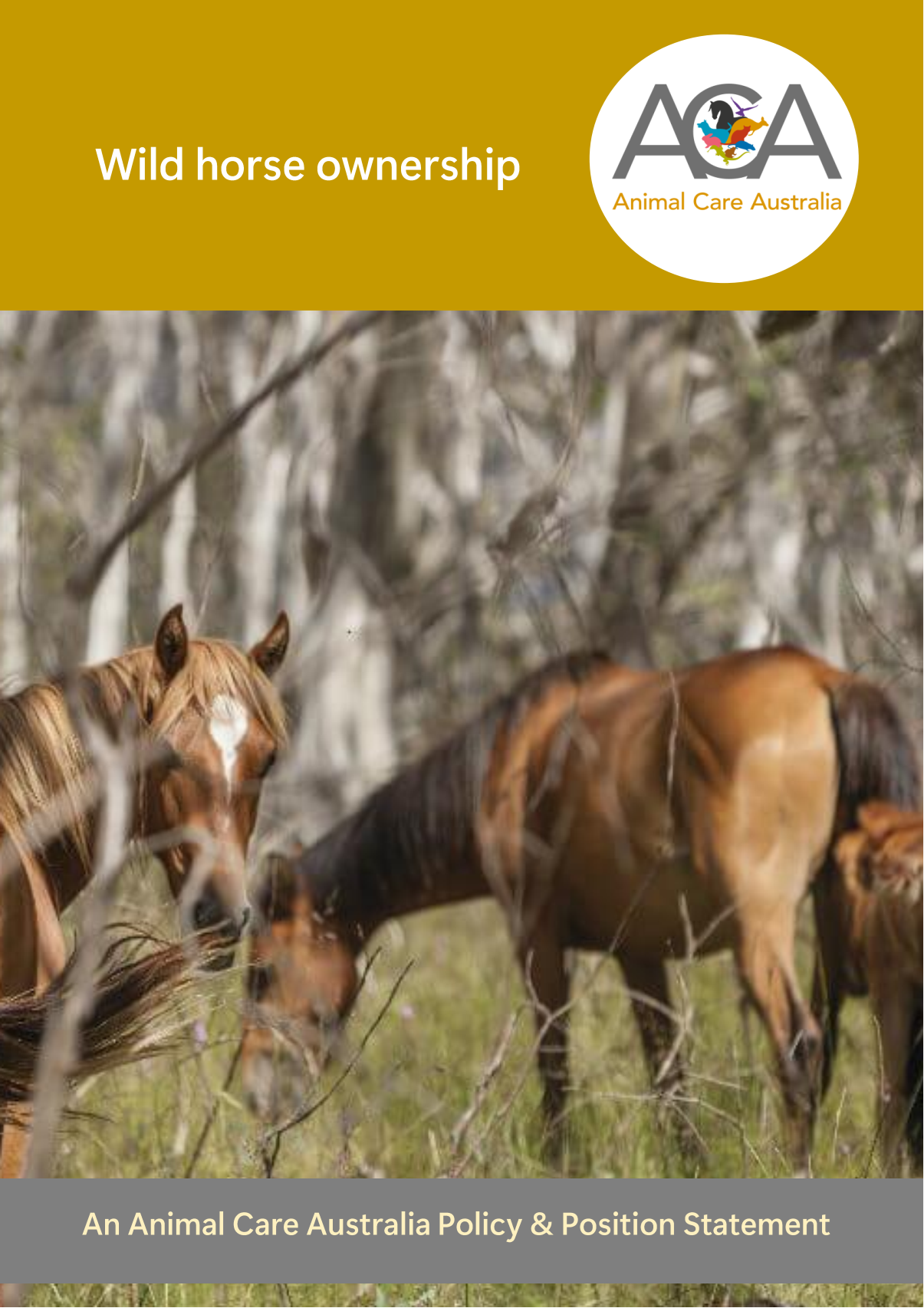
Click the image to download the Position Statement
Instead, Animal Care Australia supports the humane removal of horses from environmentally sensitive and protected areas, with removal programs incorporating yard trapping, the rehoming of suitable horses, relocation of preservation herds to appropriately managed sanctuaries, and humane ground shooting only where animals cannot genuinely be rehomed.
Animal welfare must remain at the forefront of any management program. Removing horses from environmentally sensitive areas does not have to mean that every horse removed is destined for destruction. There are other options that should be properly considered, developed and supported.
Sanctuaries can provide another pathway
Animal Care Australia is calling on Australian governments to facilitate the establishment of dedicated wild horse sanctuaries where appropriate.
Such facilities could provide managed environments for horses that hold heritage or community significance while also creating opportunities for rehoming, education, veterinary care, research, wildlife rehabilitation and carefully managed rewilding programs.
Animal Care Australia has developed the Yarraman Sanctuary concept as an example of what such a facility could look like.
The proposed model would bring together a brumby rehoming centre, veterinary and wildlife services, environmental education, tourism, equestrian activities and managed rewilding within one accountable and transparent facility.
Rather than treating wild horse management as simply a choice between doing nothing and eradication, Australia should be looking at practical models that allow us to address environmental impacts while also protecting animal welfare values.
Rehoming needs to be made workable
Animal Care Australia’s position recognises that rehoming is already occurring, but stipulates the current processes can unnecessarily restrict the number of horses able to find suitable homes.
Animal Care Australia supports active mustering and trapping programs conducted by experienced professionals, followed by appropriate assessment, handling, training and rehoming.
Animal Care Australia’s proposed sanctuary model would provide a dedicated location where trapped horses could be assessed for temperament and physical wellbeing and receive initial handling and training before progressing to suitable homes.
This is about making rehoming a genuine and viable component of population management rather than treating it as an afterthought.
Better information and accountability are essential
Animal Care Australia has consistently called for improved population monitoring and greater transparency around wild horse management and improved traceability of horses from their first point of containment through to rehoming and subsequent ownership.
Animal Care Australia supports independent and updated methods of counting wild horses and believes governments should develop achievable, long-term management plans rather than relying on short-term measures.
Governments must be accountable for the decisions they make. Sanctuary and rehoming organisations must likewise be transparent and accountable for the treatment and management of horses in their care.
A practical way forward
Animal Care Australia acknowledges that managing wild horse populations involves competing environmental, animal welfare and community considerations. Our position is that these issues should not be reduced to a polarised debate.
Wild horse management needs solutions that recognise environmental protection, animal welfare and the heritage and community significance of particular horse populations. Properly managed sanctuaries, viable rehoming pathways, improved population monitoring and humane removal programs must form part of a more comprehensive approach.
The objective should be simple: protect sensitive environments while achieving the best possible welfare outcomes for the animals involved.
Animal Care Australia’s guiding principle remains:
‘Animal welfare is animal care‘


