
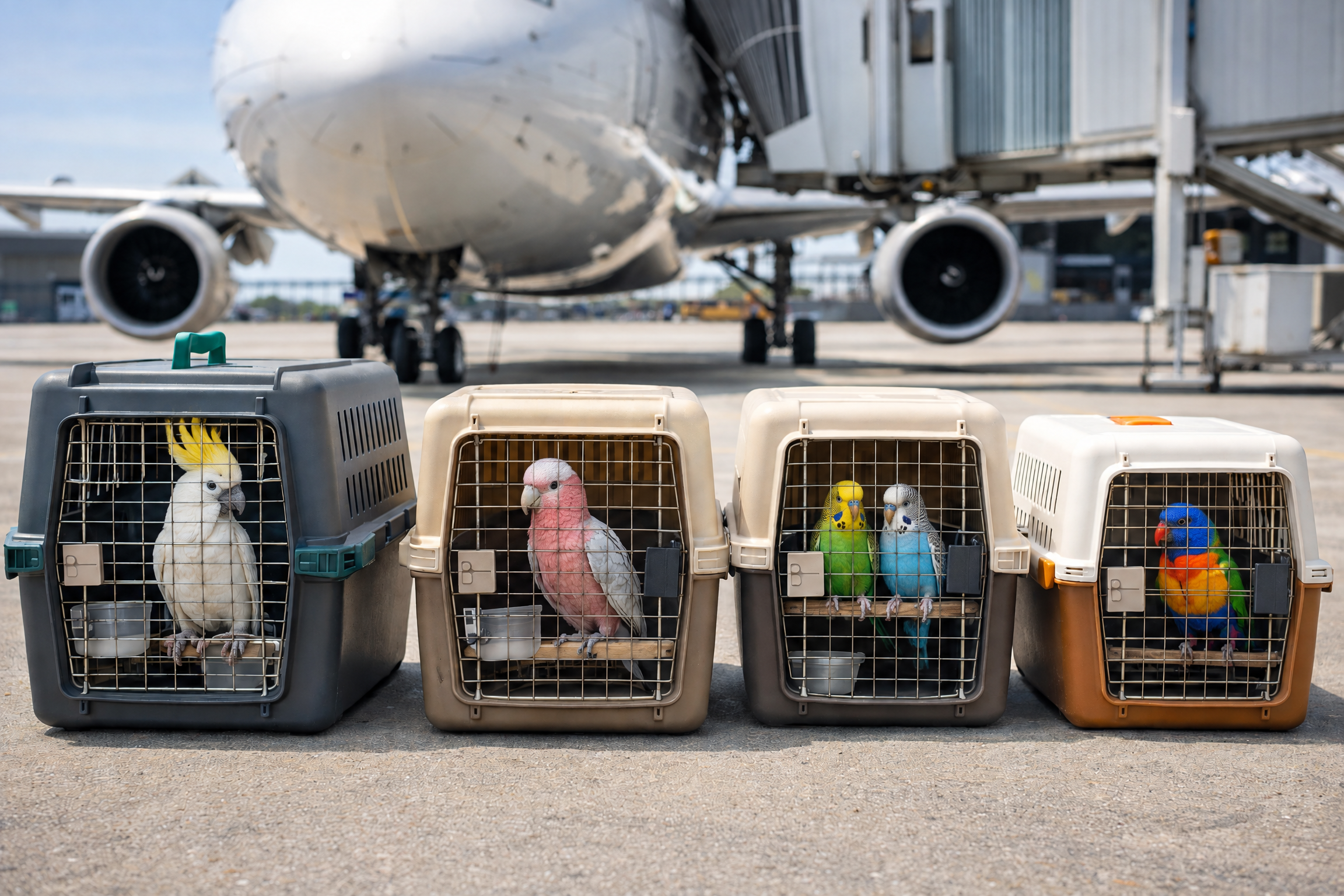
I have recently returned from the Bali Bird Congress organised by ABT (PT. Anak Burung Tropikana) and run at the Prama Sanur Beach Hotel. Fantastic conference at a terrific venue. Well done to all involved. ABT has an amazing collection of Lories, Lorikeets, Cockatoos, Eclectus, and Fig Parrots, but for us Australians it’s the collection of Hornbills that really impresses.
ABT is a commercial operation able to export to most countries but not to Australia. The owners of ABT, Johan and Marcel, would love to export to Australia and would also love to import many of our Australian species. But no, they cannot do so.
There is substantial commercial value in the trade of CAPTIVE bred birds. Note the use of capital letters for the word captive, this is important. In my view, the majority of the issues, obstacles and hurdles involved in opening Australia’s borders boil down to proving all birds traded are CAPTIVE bred.
Our Australian legislation and regulation is deliberately restricting trade. There are ways to export some non-CITES listed species and other Appendix 1 CITES species can be exported if part of approved CITES breeding programs. Natives that are listed on CITES must only go to approved breeding programs or for exhibition. Commercial sale is excluded. The paperwork and regulation is convoluted, and the reality is that currently export permits are nigh impossible and import permits are impossible.
What is so different about trade in captive bred birds compared to trade in other species such as dogs, cats, sheep, cattle, horses, etc.? So long as welfare and quarantine can be assured what is the problem?
The problem, in my view, is the media—and consequently, public perception—misusing the term ‘exotic’ to mean unusual rather than non-native. This leads to the incorrect belief that all birds are wild caught. Many readers will recall a series of articles in the Guardian newspaper some years ago. These articles and other like them continue to imply all native birds being exported were or are wild caught. I wrote to the authors and editors on each occasion requesting they make it clear all birds exported were CAPTIVE bred. They did not edit their articles.
CITES is the Convention on International Trade in Endangered Species, it is about facilitating trade not preventing trade. The aim is to protect wild populations by regulating trade in such as way as to discourage illegal trade and ensure the protection of species in the wild. CITES includes 3 appendices. Appendix I lists birds (and other animals) that are threatened with extinction hence trade must be closely monitored, Appendix II lists species where there is some concern that illegal poaching may cause extinction and Appendix III lists species of concern in particular jurisdictions.
However, when the birds are CAPTIVE bred, and the exporting country guarantees as much then the majority of the controls no longer apply, and export is greatly simplified.
Where a Management Authority of the State of export is satisfied that any specimen of an animal species was bred in captivity or any specimen of a plant species was artificially propagated, or is a part of such an animal or plant or was derived therefrom, a certificate by that Management Authority to that effect shall be accepted in lieu of any of the permits or certificates required under the provisions of Article III, IV or V.
CITES Article VII paragraph 5
Unfortunately Australian law does not implement CITES Article VII paragraph 5 as it was intended, and to be fair, until recently determining definitively that birds are captive bred was not a simple task.
Today DNA parentage testing is a relatively simple process. It proves beyond doubt that birds are CAPTIVE bred. On behalf of bird clubs in Australia (in my previous role as President of the Canary and Cage Bird Federation of Australia) we developed a substantive “Proposal for a DNA Parentage-based Export Protocol”. The proposal was presented to government but is yet to be progressed further.
In my view, the only way we will ever progress commercial trade in birds is to prove that all birds destined for export are CAPTIVE bred. Even if such proof is not required by CITES and not required by our government’s regulations, it is required by the media and hence it is required by the general public. This is the only way we will ensure borders can remain open when under the lens of public scrutiny.
For import, I’d suggest similar proof birds are captive bred is required to pass media scrutiny and the pub test. Similar DNA parentage proof is not difficult when purchasing from a commercial facility such as ABT in Bali.Australia is in a somewhat unique position compared to the majority of other countries.
- Australia has an amazing array of native bird species,
- Aviculturists in Australia are breeding most of these species routinely in captivity and have done so for numerous decades,
- Many of the birds desired for export are mutations (colour morphs) which are clearly captive bred,
- Australia has sustainable captive populations of most species suited to export, and
- Australians, including significantly the avicultural community, not only opposes trapping of wild birds but actively discourages such practices.
There is a substantial global market for our captive bred birds. What is wrong with making our amazing birds available globally? A commercial trade in captive Australian bred birds – what is wrong with that? Importing captive bred birds (with suitable quarantine controls) – what is wrong with that?
Let’s all get behind a DNA Parentage-based Protocol for both Export and Import so we prove birds are CAPTIVE bred and can get away from this wild caught innuendo nonsense forever. Only then can we hope for a sustainable import export industry.
By: Sam Davis – Animal Care Australia Bird Representative. (First published in Volume 38 Issue 8 of Australian BirdKeeper magazine) Published: June 2025 ACE Newsletter.


